In every community, there are farmers growing food, doctors treating the sick, teachers imparting knowledge, and caretakers maintaining conducive homes. If even one of these roles is neglected, the whole community would be affected. This concept is akin to the Muslim ummah, evidenced by the concept of fardhu kifayah.
Fardhu kifayah refers to actions that are obligatory upon a Muslim community as a whole, but once enough people perform it, the obligation is lifted from the rest. Examples include:
- Responding to a person saying “assalamualaikum” in a gathering
- Performing the janazah prayer
- Acquiring knowledge that is essential for a community’s survival (e.g., agriculture, medicine, mathematics, Islamic sciences)
When we hear that a field of study is fardhu kifayah, it is easy to think, “I see other Muslims learning it, so that means I don’t have to”. On the contrary, we should say, “I will learn this and put it into practice so that others are relieved of this obligation”. In Islam, this sense of personal responsibility toward the community is imperative. Yet, there still exists a widespread assumption that the responsibility of learning is exclusive to scholars.
Rethinking Who Islamic Education is For
Allah SWT says in the Qur’an:
وَنَزَّلْنَا عَلَيْكَ ٱلْكِتَـٰبَ تِبْيَـٰنًۭا لِّكُلِّ شَىْءٍۢ وَهُدًۭى وَرَحْمَةًۭ وَبُشْرَىٰ لِلْمُسْلِمِينَ ٨٩
“…And We have sent down to you the Book as clarification for all things and as guidance and mercy and good tidings for the Muslims.” (Surah An-Nahl 16:89)
Islam is a comprehensive (shumul) religion that covers both worldly and spiritual affairs. Islamic education, therefore, is not reserved for aspiring religious teachers. It is for every profession, from finance to psychology to law and even the halal industry. Now, the question comes: how should we learn?
Learning Beyond the Scroll
In today’s technological era, many of us are accustomed to bite-sized learning on social media and video platforms like YouTube and TikTok. We want information to be concise enough to be processed within seconds. We would rather watch a lecture recording at 1.5x speed than attend a class in person. We want quick, short answers to our questions.
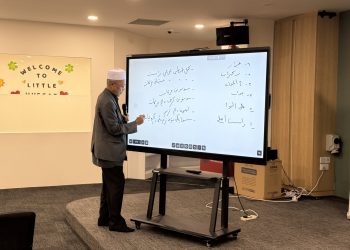
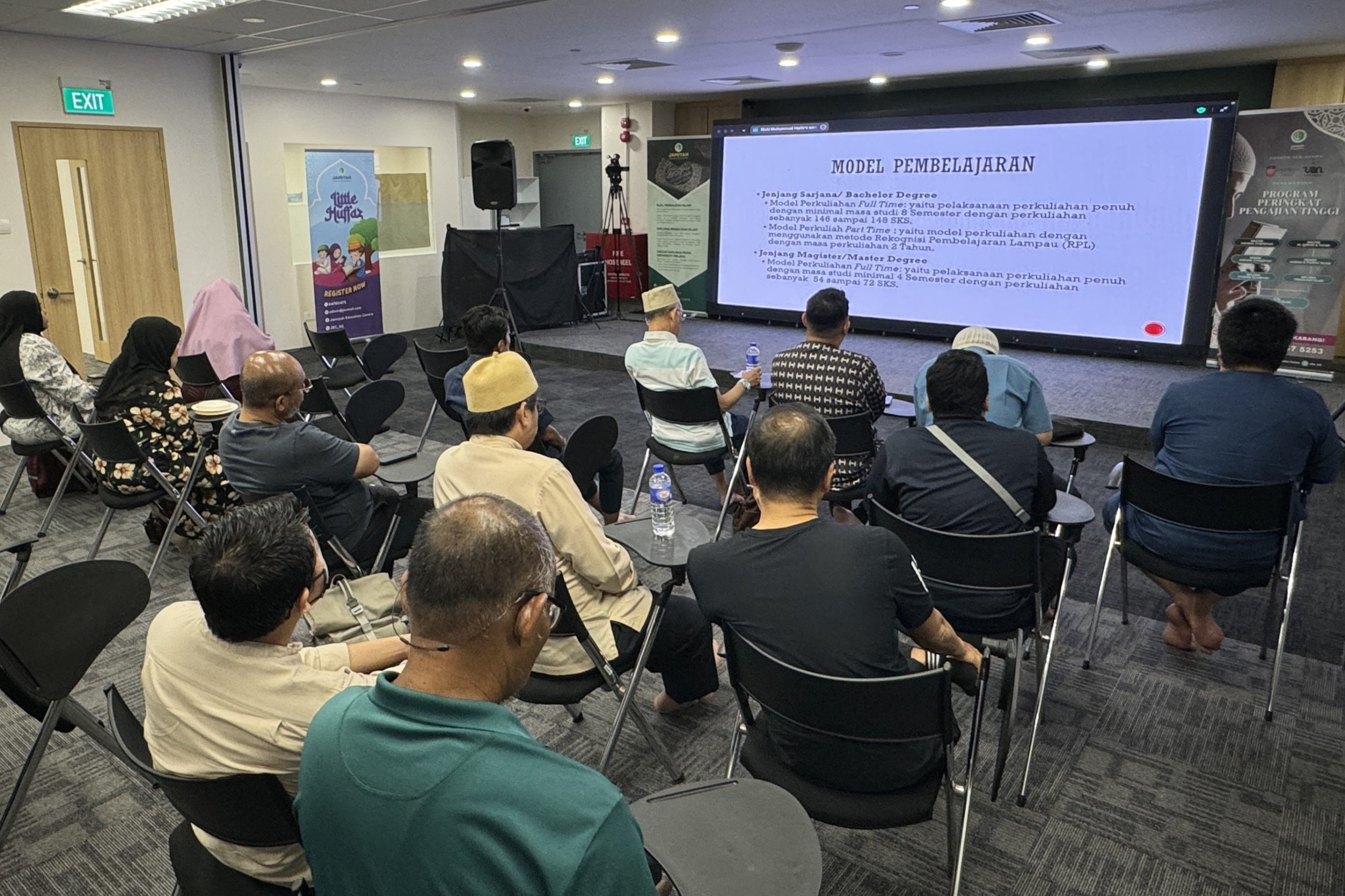
However, knowledge cannot be acquired the way entertainment is consumed. Effective learning requires time, a structured curriculum, quality learning materials, regular assessments and revision, discussions with peers, and opportunities to ask questions and learn from others.
Yet, even when we accept this truth, taking the first step is not always easy.
Silencing the Whispers
Sometimes, we hesitate to enter religious spaces because we assume everyone else is more righteous and knowledgeable, and we fear we would not be worthy of the knowledge shared upon us.
These thoughts are not signs of humility. They are whispers from Shaytan.
As mentioned in Surah An-Naas, verses 4 – 5:
مِن شَرِّ ٱلْوَسْوَاسِ ٱلْخَنَّاسِ ٤ ٱلَّذِى يُوَسْوِسُ فِى صُدُورِ ٱلنَّاسِ ٥
“from the evil of the lurking whisperer; who whispers into the hearts of humankind”
Indeed, Shaytan loves to lead the believers toward ignorance. If he cannot stop us from worshipping altogether, he will try to stop us from growing and benefiting others. He wants us to believe that fardhu kifayah is not of importance.
Allah SWT warned us:
يَعِدُهُمْ وَيُمَنِّيهِمْ ۖ وَمَا يَعِدُهُمُ ٱلشَّيْطَـٰنُ إِلَّا غُرُورًا ١٢٠
“Shaytan only makes them ˹false˺ promises and deludes them with ˹empty˺ hopes. Truly, Shaytan promises them nothing but delusion.” (Surah An-Nisa 4:120)
Let us not fall for Shaytan’s deception.
As believers (mu’minin), our responsibility is to learn with the intention of worship, make du’a that Allah SWT eases our learning, and remain consistent in revising and applying what we learn.
Now, only one question remains: Will we make time to seek knowledge?
Honouring the Gift of Time
Time is a non-renewable resource. Every minute offers an opportunity to make a choice. To pray or to delay. To donate or to withhold. To learn or to not know.
Making a weekly commitment to learn may seem daunting at first, especially when it means giving up other activities. It is only when we step into the classroom that we realise the sheer magnitude of a blessing that Allah SWT is granting us, for choosing us to sit among the angels and His righteous worshippers in a garden from the gardens of Paradise.
May Allah SWT make us among those who fulfil the fardhu kifayah through consistent learning and grant us the ability to put our knowledge into practice.
———————————————————————————————————-
Experience International Islamic College (IIC) education in Singapore with Jamiyah Academy!
Jamiyah Academy collaborates with IIC, a private higher education institution wholly owned by International Islamic University Malaysia (IIUM), to offer you diploma programmes that cater to your learning needs and preferences. Select your preferred course for more details: